Analyzing Housing Prices in Shanghai with Open Data: Amenity, Accessibility and Urban Structure
Cities · 2019
Contribution
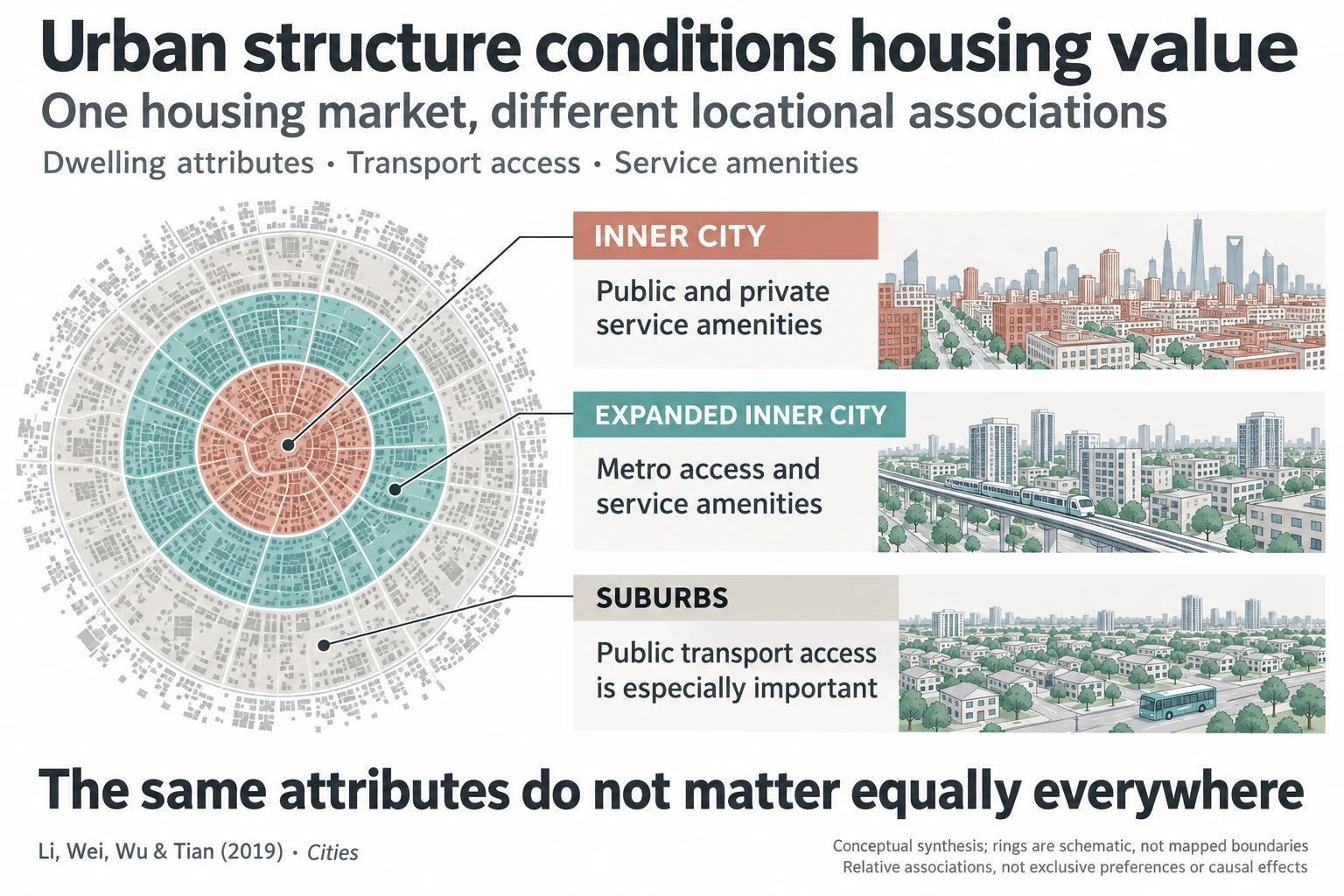
Associations between housing prices, dwelling attributes, transport access and service amenities need to be understood within metropolitan spatial structure. An integrated framework compares Shanghai's inner city, expanded inner city and suburbs, showing that the same locational attributes have different associations across urban zones. It moves the analysis beyond a single city-wide average relationship toward an explanation of spatial context.
Findings and approach
- The study combines 47,790 housing listings with open amenity data, spatial regression and urban-zone comparisons to examine Shanghai's monocentric housing market.
- Public and private service amenities feature prominently in the inner city; metro access and service amenities matter in the expanded inner city; transport accessibility is especially important in the suburbs.
- These are relative associations, not evidence that suburban amenities or inner-city transport are irrelevant. Listing data and regression results do not establish causal effects.