Innovation, Network Capabilities, and Sustainable Development of Regional Economies in China
Sustainability · 2019
Contribution
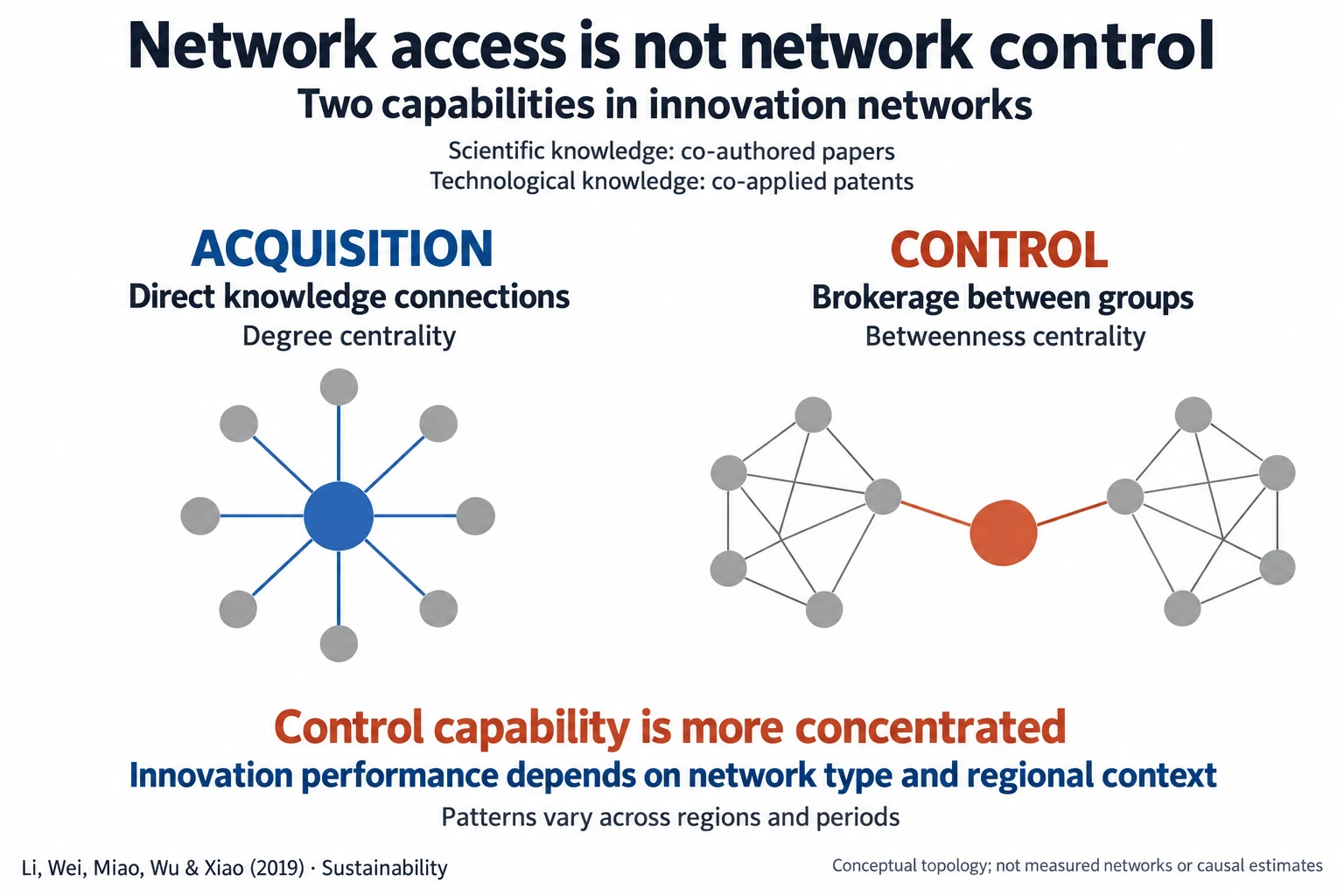
The number of knowledge connections and a region's brokerage position are distinct network advantages. By separating scientific and technological knowledge networks, the study links acquisition and control capabilities to local innovation resources and performance. Place advantages arise from interregional relationships as well as local resources, but their relevance varies by knowledge type, region and period: more connections do not necessarily imply stronger innovation.
Findings and approach
- Co-authored papers and co-applied patents in biotechnology from 2000 to 2012 define scientific and technological knowledge networks. Degree centrality measures acquisition capability; betweenness centrality measures control capability.
- Technological knowledge networks are smaller than scientific networks. Control capability is more concentrated than acquisition capability, revealing a core-periphery structure.
- Network-performance associations differ across regions and periods, including their direction in some models. Sustainable-development implications are not independently verified causal outcomes.