Urban Amenity, Human Capital and Employment Distribution in Shanghai
Habitat International · 2019
Contribution
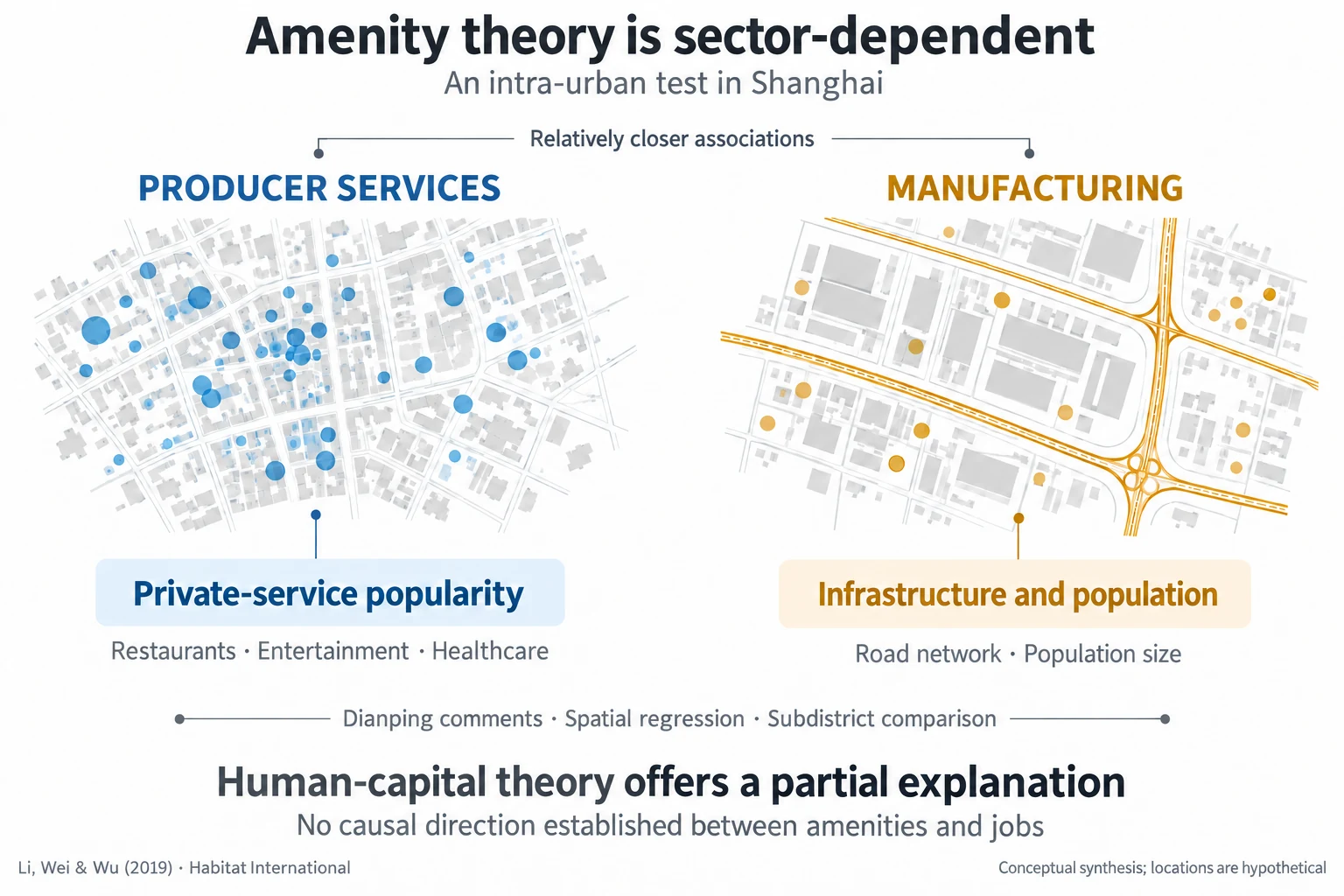
Amenity-oriented and human-capital theories do not provide a uniform locational explanation for every industry. Using Dianping comment counts to measure private-service popularity, the study compares producer-service and manufacturing employment within Shanghai. It shows that explanatory relevance depends on amenity category and sector, extending the intra-urban test while identifying limits to an amenity-only account of employment agglomeration.
Findings and approach
- Spatial regressions relate subdistrict employment to private-service comment counts. Review popularity is a proxy, not a direct measure of residents' satisfaction.
- Producer-service employment is relatively more closely associated with private-service amenities; manufacturing is more related to transport infrastructure and local population. Neither sector has an exclusive set of determinants.
- Human-capital theory receives partial support. The study does not directly observe skilled workers as a mediator or establish the causal direction between amenities and jobs.