Firm Suburbanization in the Context of Urban Sprawl: Neighborhood Effect and Sectoral Difference
The Professional Geographer · 2020 · First author
Contribution
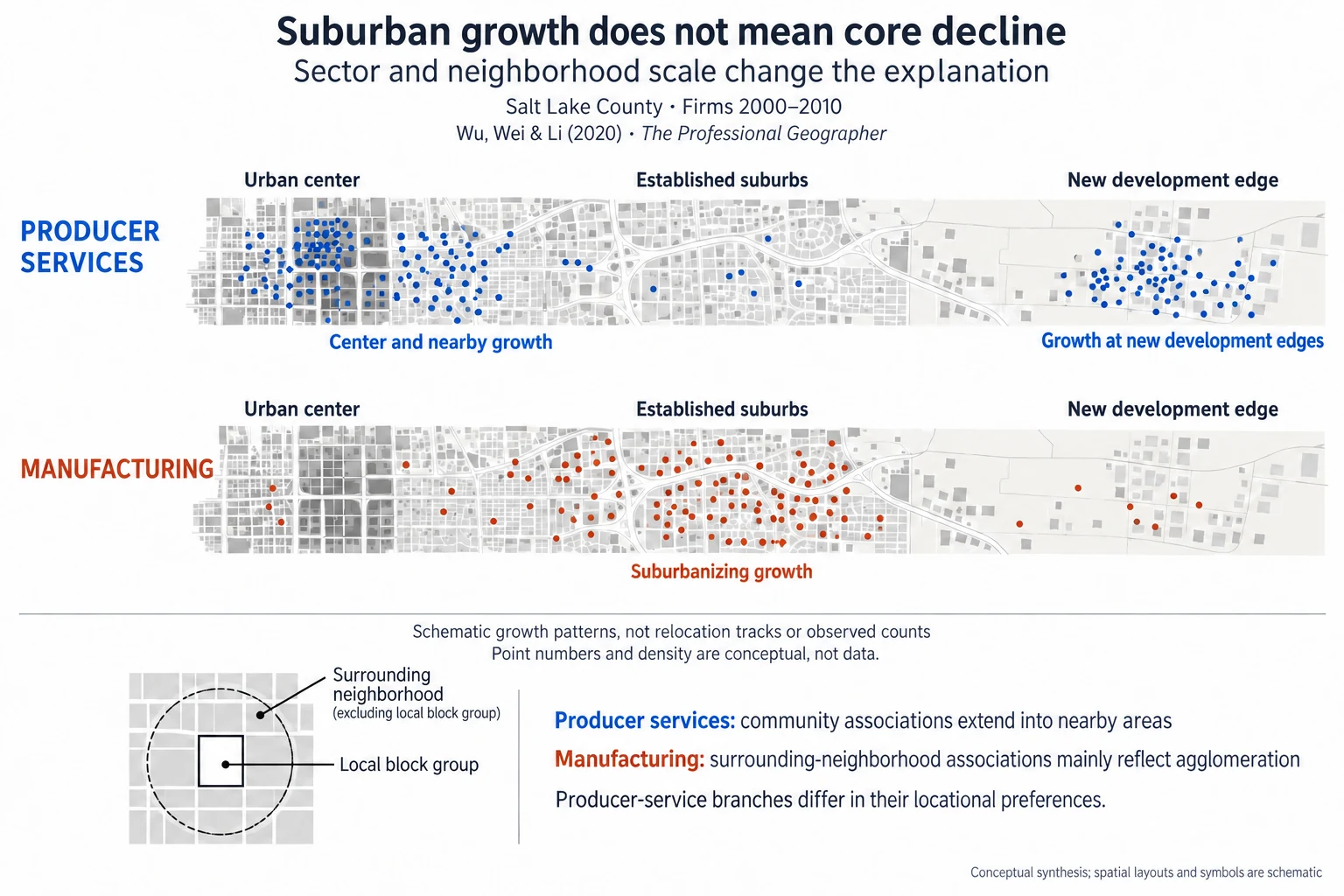
Firm suburbanization is neither equivalent to core decline nor a uniform outward shift across industries. Comparing manufacturing and producer services in Salt Lake County, the study distinguishes local block-group conditions from surrounding-neighborhood conditions. It brings central and nearby growth, edge growth and within-sector differences into one framework, showing why sector, neighborhood scale and urban context matter to explanations of suburbanization.
Findings and approach
- Firm data for 2000–2010 show suburbanizing manufacturing growth, while producer services combine center and nearby growth with growth at newly developed edges. Peripheral and central growth can coexist.
- Producer services are more sensitive to community characteristics, with associations extending into nearby areas. At the surrounding-neighborhood scale, manufacturing mainly shows agglomeration associations; local community conditions are not thereby irrelevant.
- Locational associations differ among producer-service branches. The analysis relates establishment counts to spatial conditions; it does not track individual firm relocations or establish causal mechanisms.