Regional Inequality, Spatial Polarization and Place Mobility in Provincial China: A Case Study of Jiangsu Province
Applied Geography · 2020
Contribution
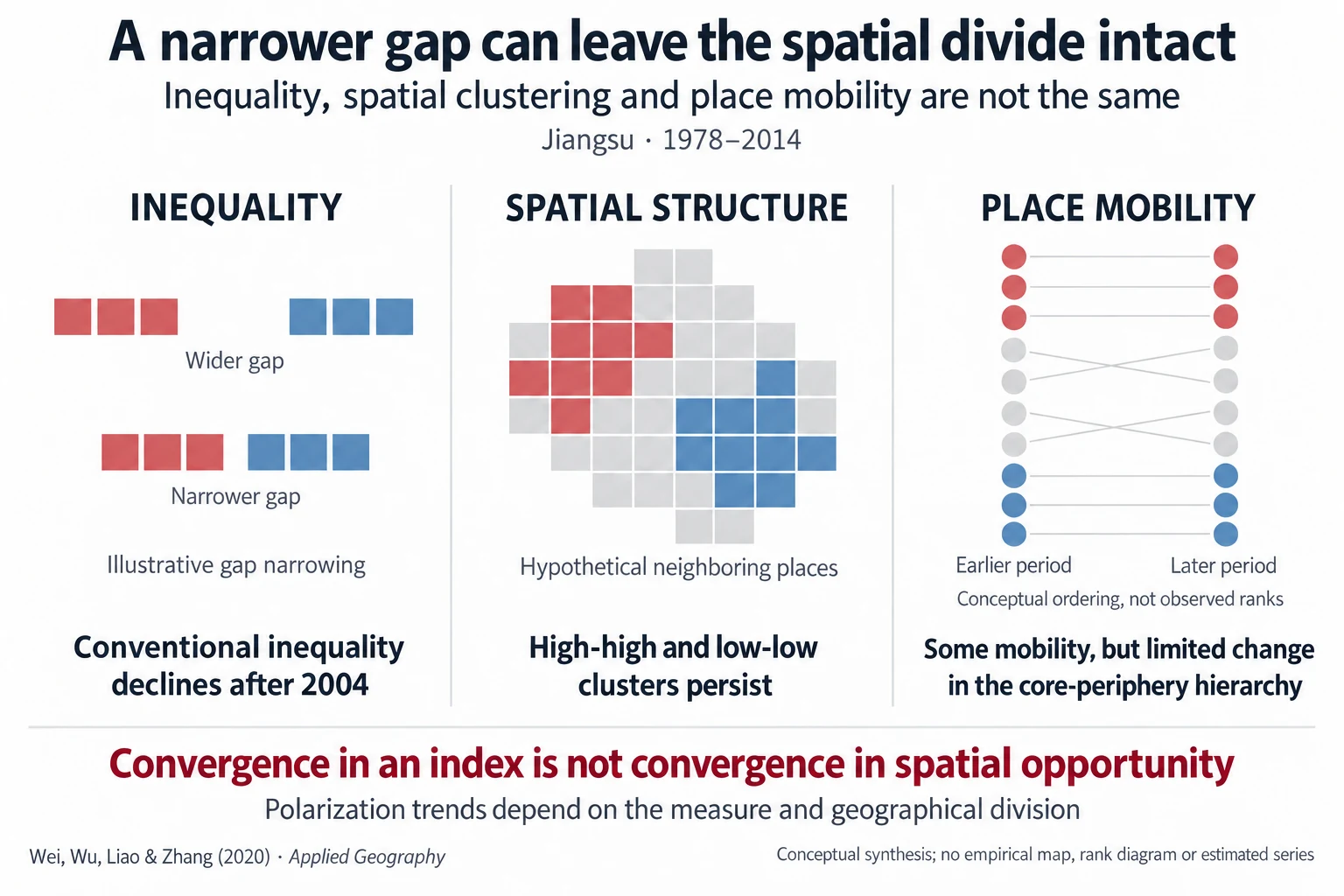
A narrower economic gap is not the same as a changed spatial core-periphery structure. Separating inequality, polarization and mobility in places' development positions, the study shows how declining conventional inequality can coexist with persistent clusters of high and low development and limited upward mobility. It moves regional-development assessment beyond a single convergence-or-divergence verdict toward a multiscale account of gaps, spatial structure and place opportunities.
Findings and approach
- The study compares Jiangsu's development from 1978 to 2014 using inequality decomposition, spatial autocorrelation, place-mobility analyses and self-organizing maps across scales and geographical divisions.
- Conventional inequality declines after 2004, while high-high clusters in southern Jiangsu and southern central Jiangsu and low-low clusters in northern Jiangsu remain persistent. Polarization trends depend on the measure and regional division.
- Some places change development position without overturning the overall core-periphery hierarchy. Place mobility means changes in regions' development status, not population migration, and does not imply that every poorer region has zero upward mobility.