Trip Generation, Trip Chains and Polycentric Development in Metropolitan USA: A Case Study of the Wasatch Front Region, Utah
Applied Geography · 2021
Contribution
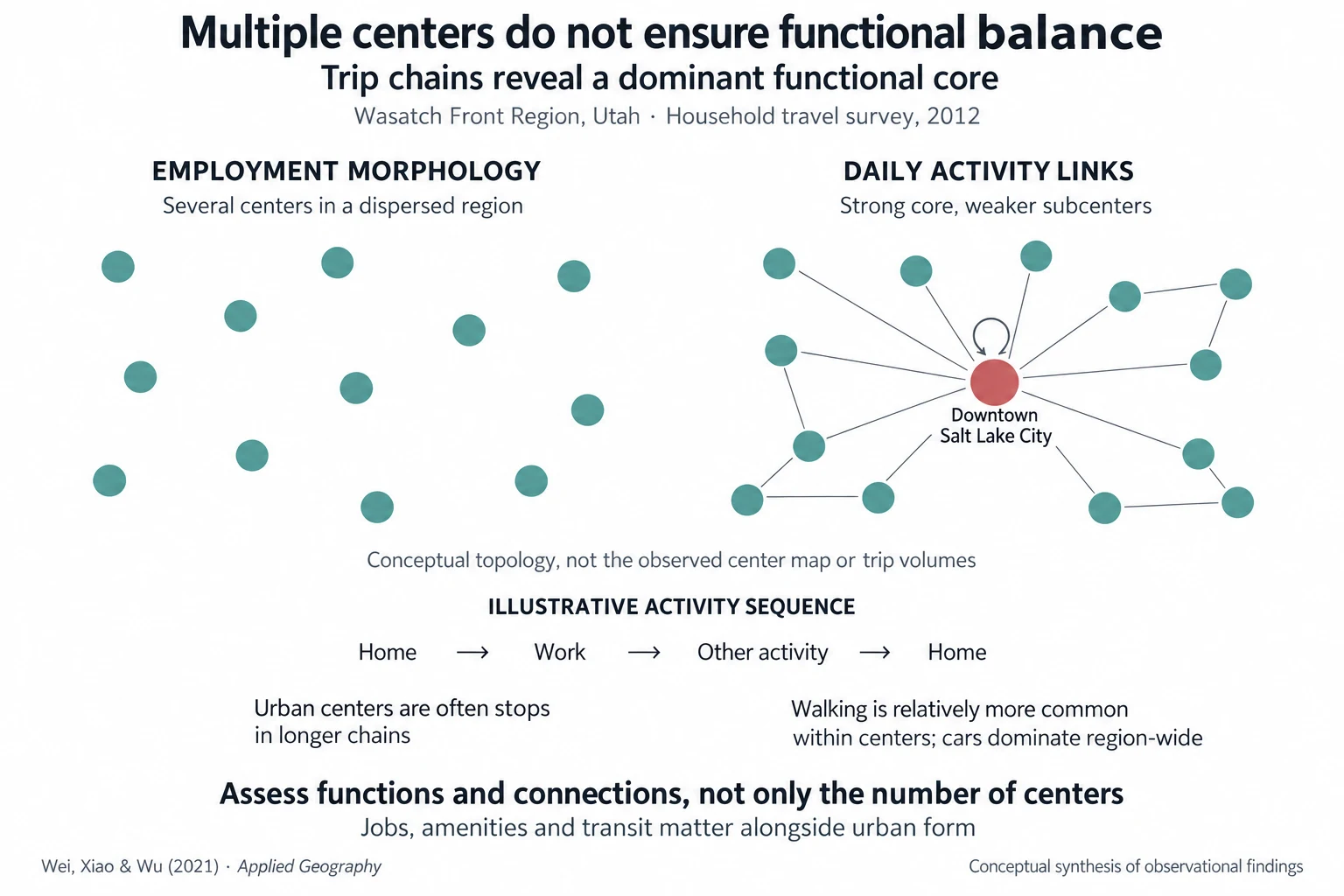
Multiple employment centers do not necessarily imply balanced metropolitan functions. Comparing employment-based morphology with household trip-chain evidence, the study finds that the Wasatch Front has several centers but daily activity links remain dominated by downtown Salt Lake City. It moves the assessment of polycentricity beyond center counts and densities toward their connections and role in everyday activity, without treating limited functional balance as proof that polycentric planning has failed.
Findings and approach
- Employment data identify centers, while the 2012 household travel survey supports comparisons of trip chains, modes and connections within and outside those centers.
- Downtown Salt Lake City is the main functional core, with weaker links among other centers. Centers are more often stops in longer activity chains than generators of chains contained entirely within them.
- Walking is relatively more common within centers, but automobiles dominate region-wide. Jobs, amenities and transit inform the policy discussion; survey and model associations do not establish causal intervention effects.