Neighborhood, Built Environment and Resilience in Transportation during the COVID-19 Pandemic
Transportation Research Part D: Transport and Environment · 2022
Contribution
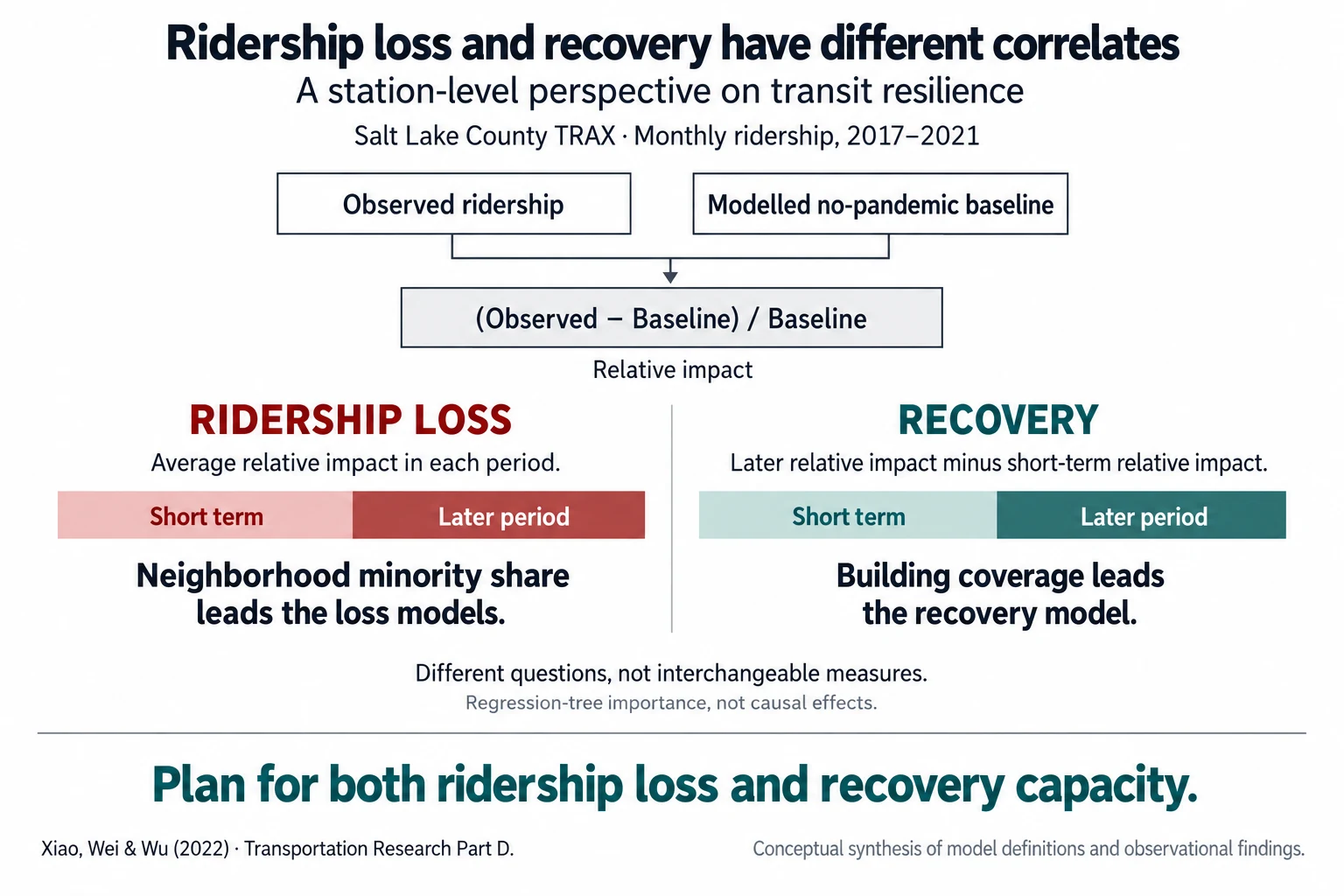
Ridership loss and recovery capacity are distinct questions. A Bayesian structural time-series model estimates a no-pandemic ridership baseline, against which station-level relative losses and their change across two periods are compared. The Salt Lake County light-rail case identifies different leading neighborhood correlates of loss and recovery. Transit resilience therefore cannot be inferred from the size of a ridership decline or explained by one built-environment indicator alone.
Findings and approach
- Monthly station ridership from 2017 to 2021 is compared with a modelled baseline. Recovery is the later-period relative impact minus the earlier-period impact, not evidence that ridership has fully returned to its pre-pandemic level.
- Neighborhood minority share has the highest regression-tree importance in both loss models; building coverage has the highest importance in the recovery model. These are predictive associations, not causal attributions to ethnicity or environmental conditions.
- The sharp early drop coincides with stay-at-home guidance, while later case peaks do not produce the same decline. The discussion emphasizes policy context, neighborhood differences and open space around stations without directly identifying the underlying infection-mobility mechanism.