Regional Development and Inequality within City Regions: A Study of the Yangtze River Delta, China
Geographical Review · 2023
Contribution
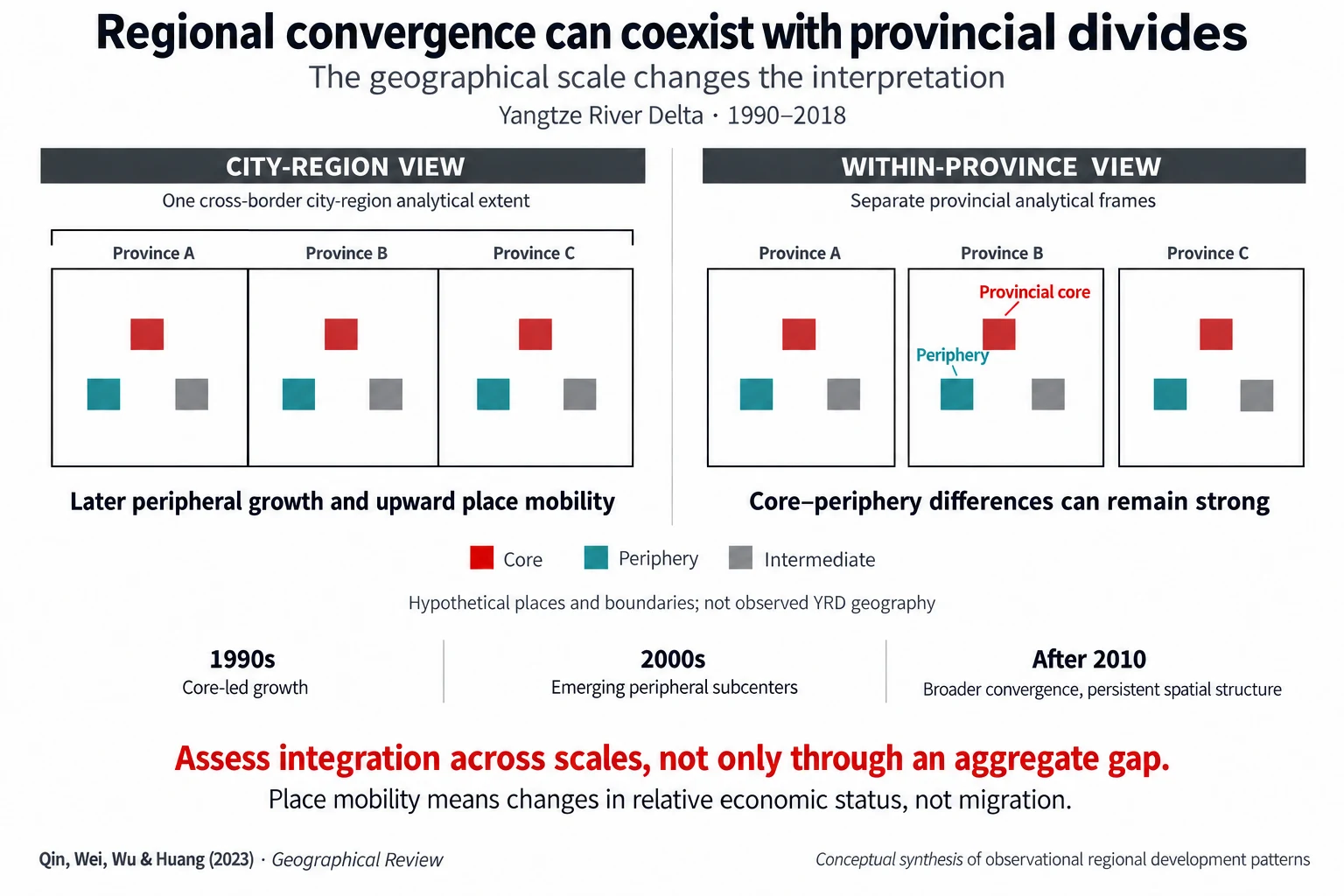
Convergence across a city-region does not mean that provincial core-periphery divides have disappeared. Linking regional inequality, spatial polarization and changes in places' relative development positions, the study follows the Yangtze River Delta from 1990 to 2018. A cross-border city-region has its own spatial structure rather than simply combining provincial patterns. Assessing integration therefore requires attention to both development stage and geographical scale.
Findings and approach
- Early growth and upward place mobility are concentrated in core regions; later peripheral growth and upward movement accompany some decline in overall inequality and polarization. Place mobility concerns relative economic status, not population migration.
- Peripheral subcenters emerge alongside wider integration, while new concentrations and provincial core-periphery structures persist. Aggregate city-region measures do not fully represent those divides.
- City-regions form a cross-border scale for inequality analysis. Polycentric development and peripheral support are policy implications, not identified causal effects of integration policies.