Regional Drinking Water Supply in Pakistan: Regional Disparity, Inequality, and Development Pattern
The Professional Geographer · 2023 · First author
Contribution
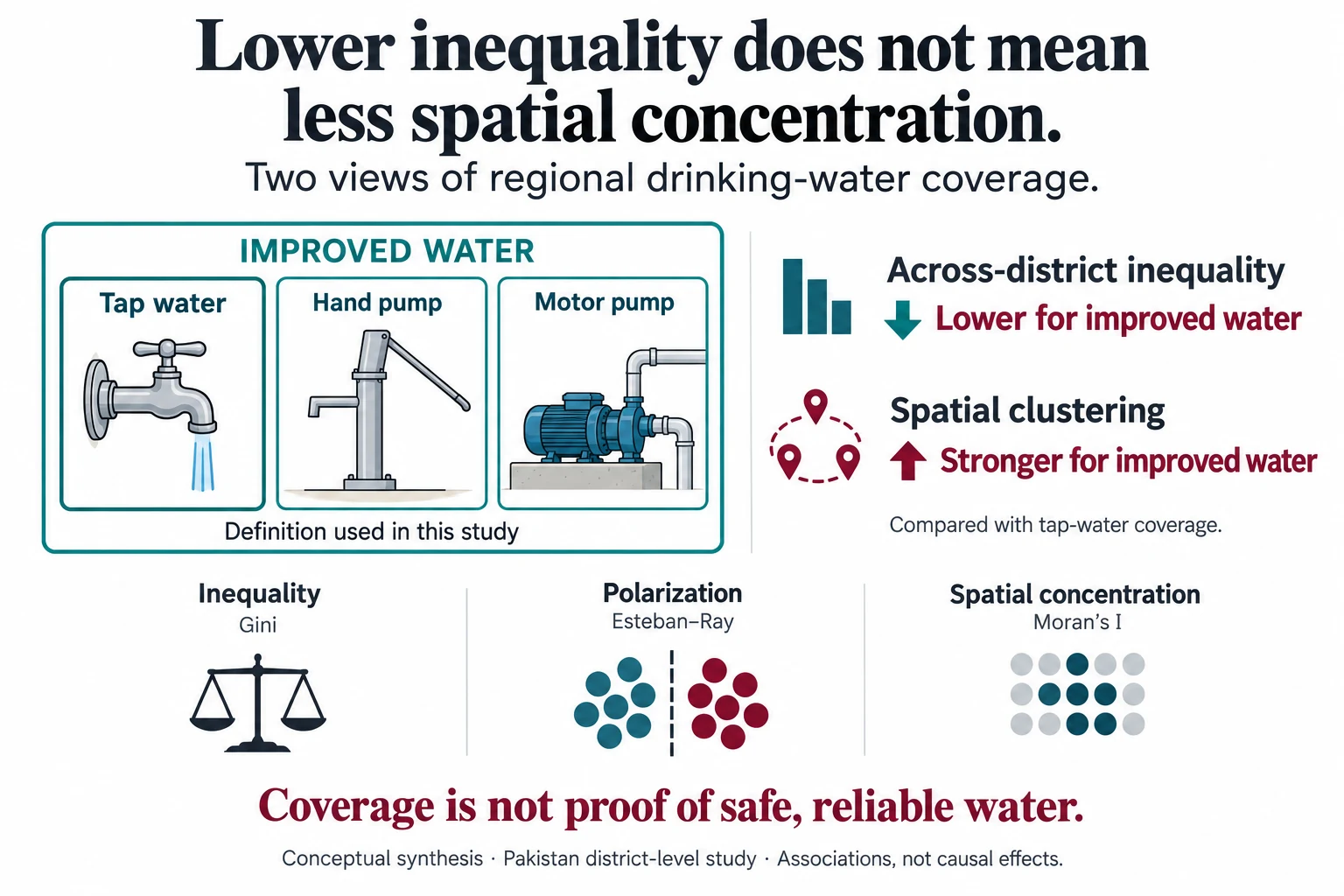
Smaller regional gaps in drinking-water coverage do not necessarily imply less spatial exclusion. Combining inequality, polarization and spatial concentration, the study finds lower non-spatial inequality but stronger spatial concentration for improved-water coverage than for tap-water coverage in Pakistan. Tap water is a subset of improved sources; the two measures reveal different regional patterns and associated conditions, showing why a single coverage or inequality indicator is insufficient.
Findings and approach
- The 2015 source survey covers 112 districts. Improved sources include tap water, hand pumps and motor pumps, rather than a mutually exclusive second system.
- Tap-water coverage is more closely associated with environmental conditions; improved-water coverage is more sensitive to demographic conditions, with urban-rural differences.
- Lower non-spatial inequality can conceal spatial clustering and exclusion. Quality, accessibility and availability need separate assessment, not inference from source category alone.