Remote Sensing of Watershed: Towards a New Research Paradigm
Remote Sensing · 2023
Contribution
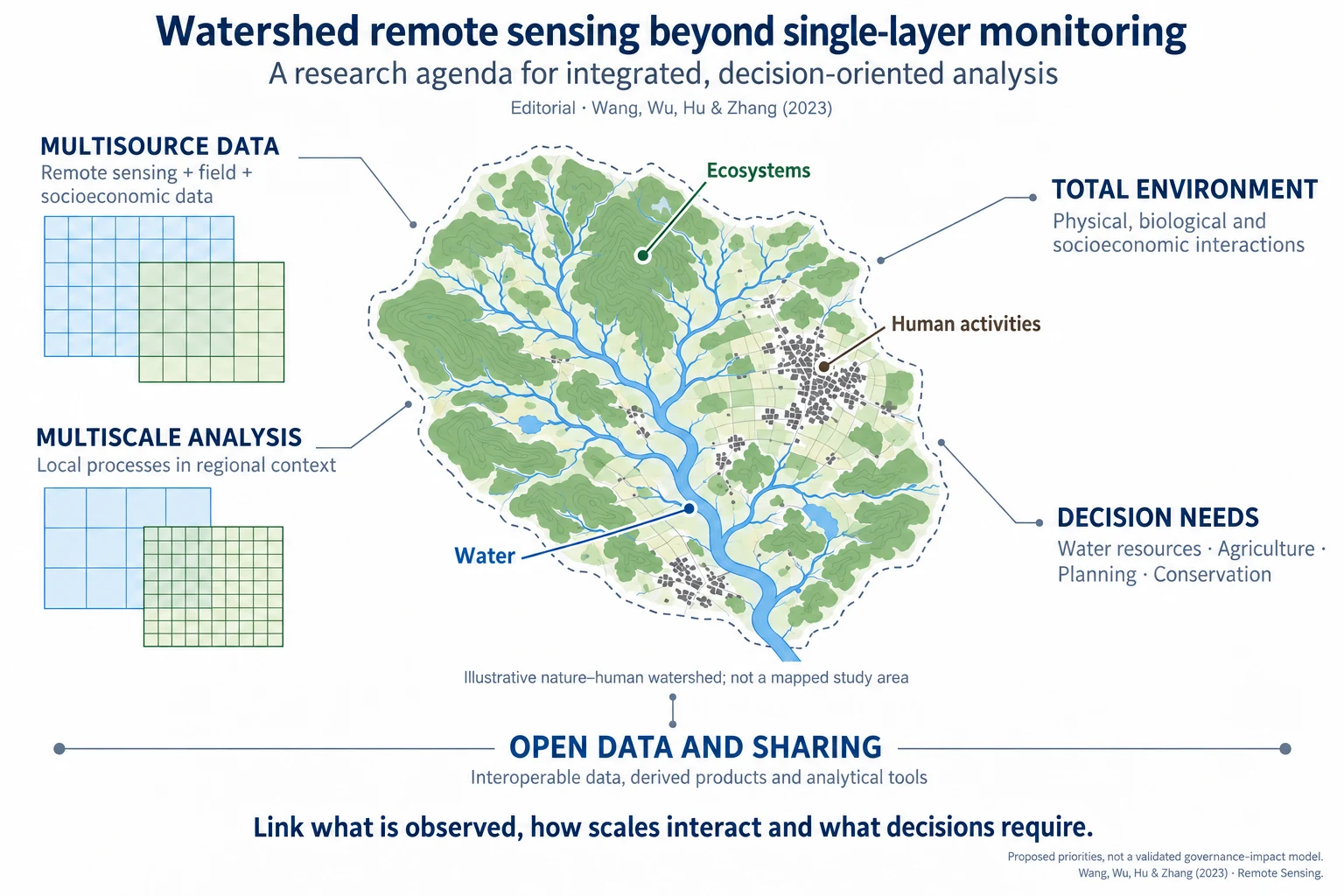
Watershed remote sensing needs to connect natural processes, human activities and decision requirements rather than monitor one environmental layer in isolation. This special-issue editorial synthesizes the multiscale, multidimensional and interdisciplinary character of watershed research and proposes an agenda linking multisource data, scale interactions and the total environment. Its contribution is a research perspective and set of priorities, not a newly validated governance outcome.
Findings and approach
- The editorial synthesizes 14 special-issue papers and treats watersheds as interconnected nature-human systems, bringing physical, biological and socioeconomic processes into one research perspective.
- Five priorities are proposed: multisource integration, multiscale modelling, total-environment analysis, overcoming data barriers and sharing, and addressing industry and decision needs.
- Remote sensing is proposed alongside field observations, socioeconomic information and other geospatial data, supported by interoperable data and tools. The article adds no new empirical dataset or quantified governance-benefit evaluation.