Characterizing Sprawl Development in Urban China: A Perspective from Urban Amenity
Land · 2023
Contribution
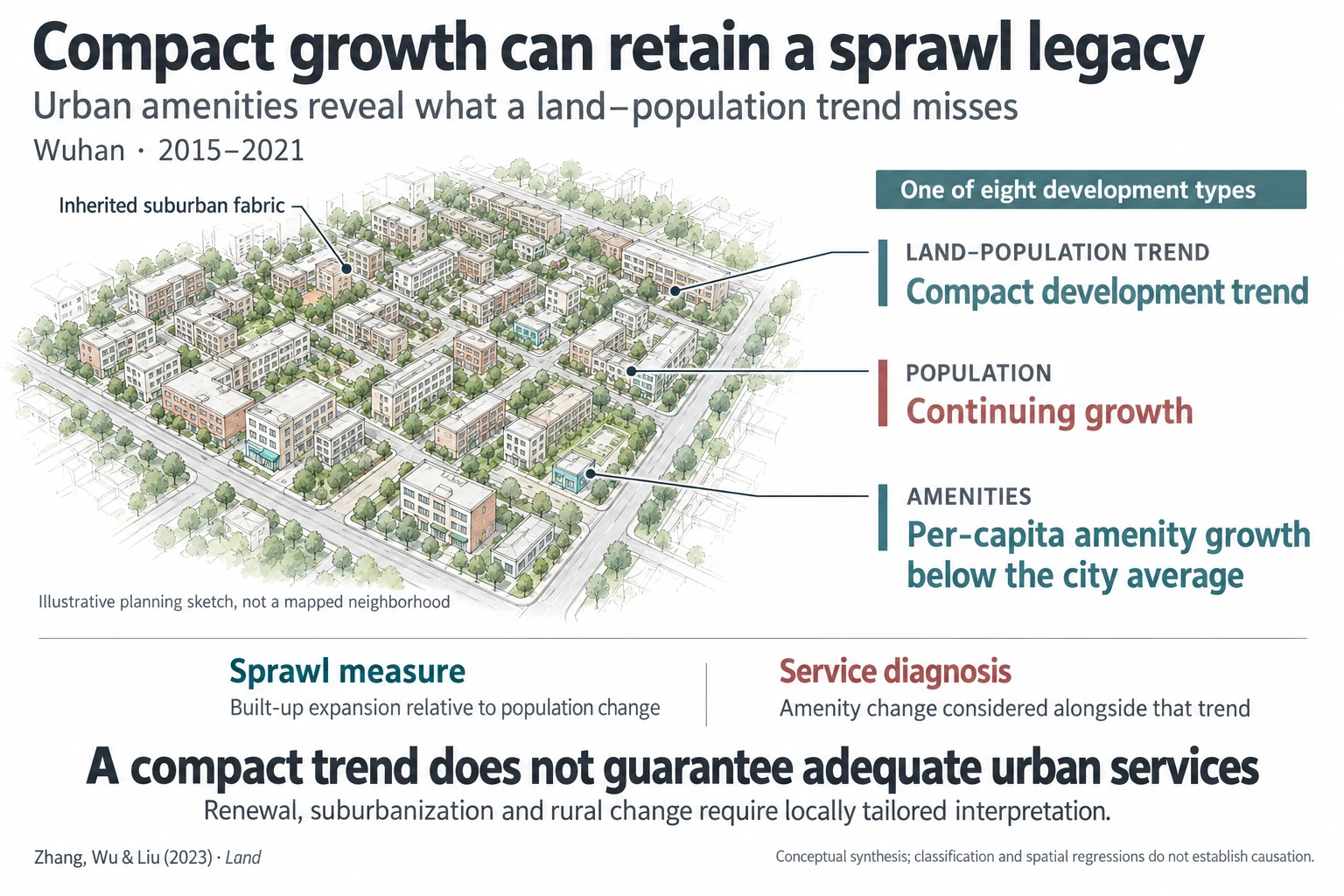
A compact-development trend does not guarantee adequate urban services. The study measures sprawl through built-up expansion relative to population change, then brings amenity change into the classification of Wuhan subdistricts. One important type combines compact growth, continued population growth and per-capita amenity growth below the city average. The contribution extends morphological diagnosis to inherited development patterns and the fit between growth and service provision.
Findings and approach
- Population, remote-sensing and POI data for 2015-2021 support eight development types combining sprawl trend, amenity change and demographic change. Amenities are not a direct component of the sprawl-index formula.
- Renewal, suburbanization and rural change produce different combinations. Some traditional suburbs show compact trends while retaining service shortfalls associated with past sprawl, not a universal shortage in every suburb.
- Spatial filtering and geographically weighted regression describe associations and local variation, not causation. POIs and land cover do not directly measure service quality, residents' use or detailed land-use functions.