Urban Form, Air Pollution, and Walking Behavior: A Study of Salt Lake County, Utah
Journal of Transport & Health · 2023
Contribution
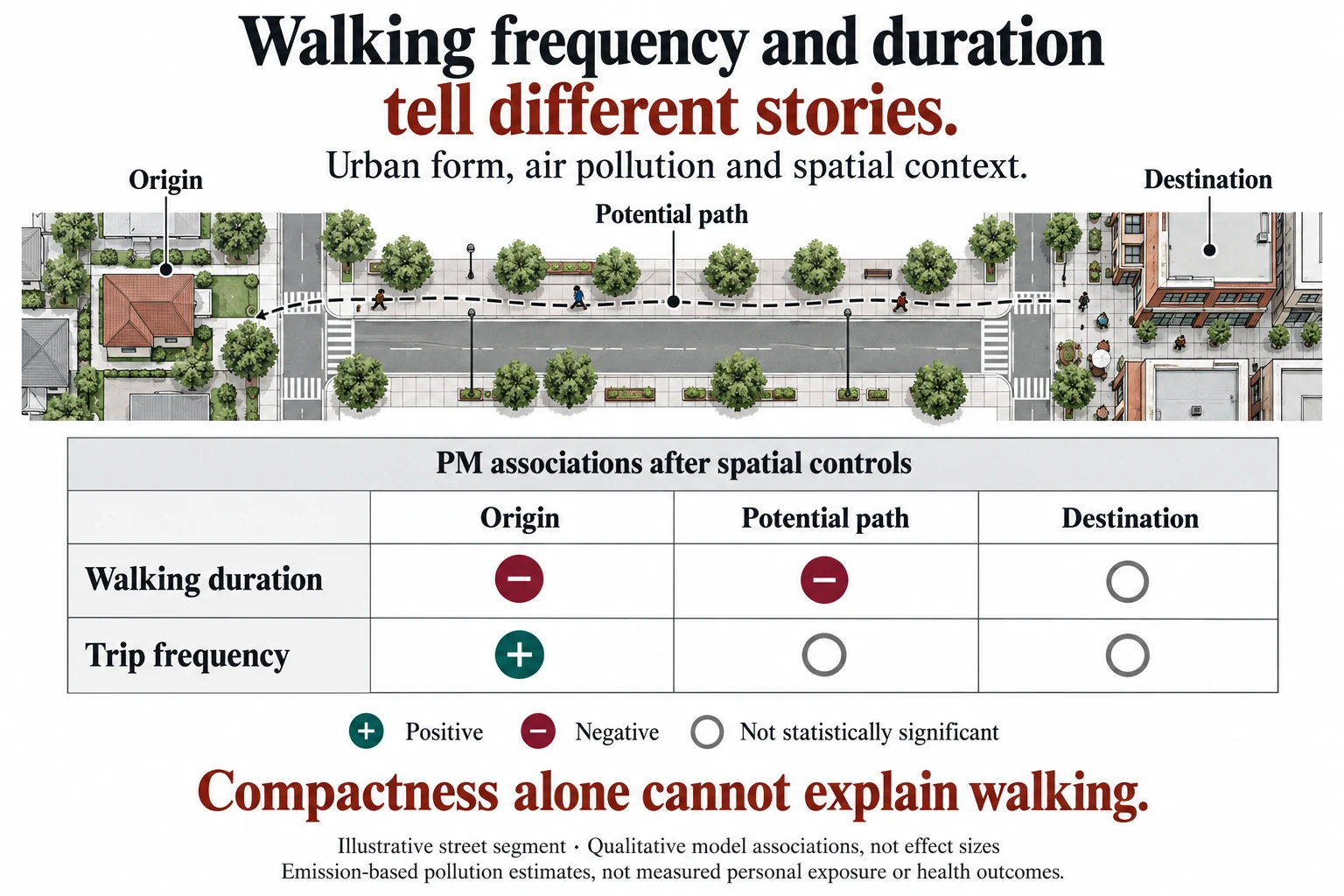
More walking trips do not necessarily mean longer walks or a healthier environment. Separating origins, destinations and potential paths, the study models frequency and duration with spatial controls. Associations with compact land use vary by outcome and spatial position, while frequent but shorter walks can coincide with higher pollution indicators. The contribution is a joint analysis of activity, spatial context and environmental burden, rather than a single walkability measure.
Findings and approach
- After spatial controls, compact land use is not significantly associated with higher frequency and is negatively associated with potential-path walking duration.
- Job-type mixture is positively associated with origin and destination frequency and duration, while housing-job mixture has negative associations in these models.
- PM associations differ across frequency, duration and spatial position. Pollution estimates are not personal doses, and the models do not measure health improvements or causal effects.