Urban Form and Spatiotemporal Vulnerability of Local Communities to COVID-19
Geographical Review · 2023 · First author
Contribution
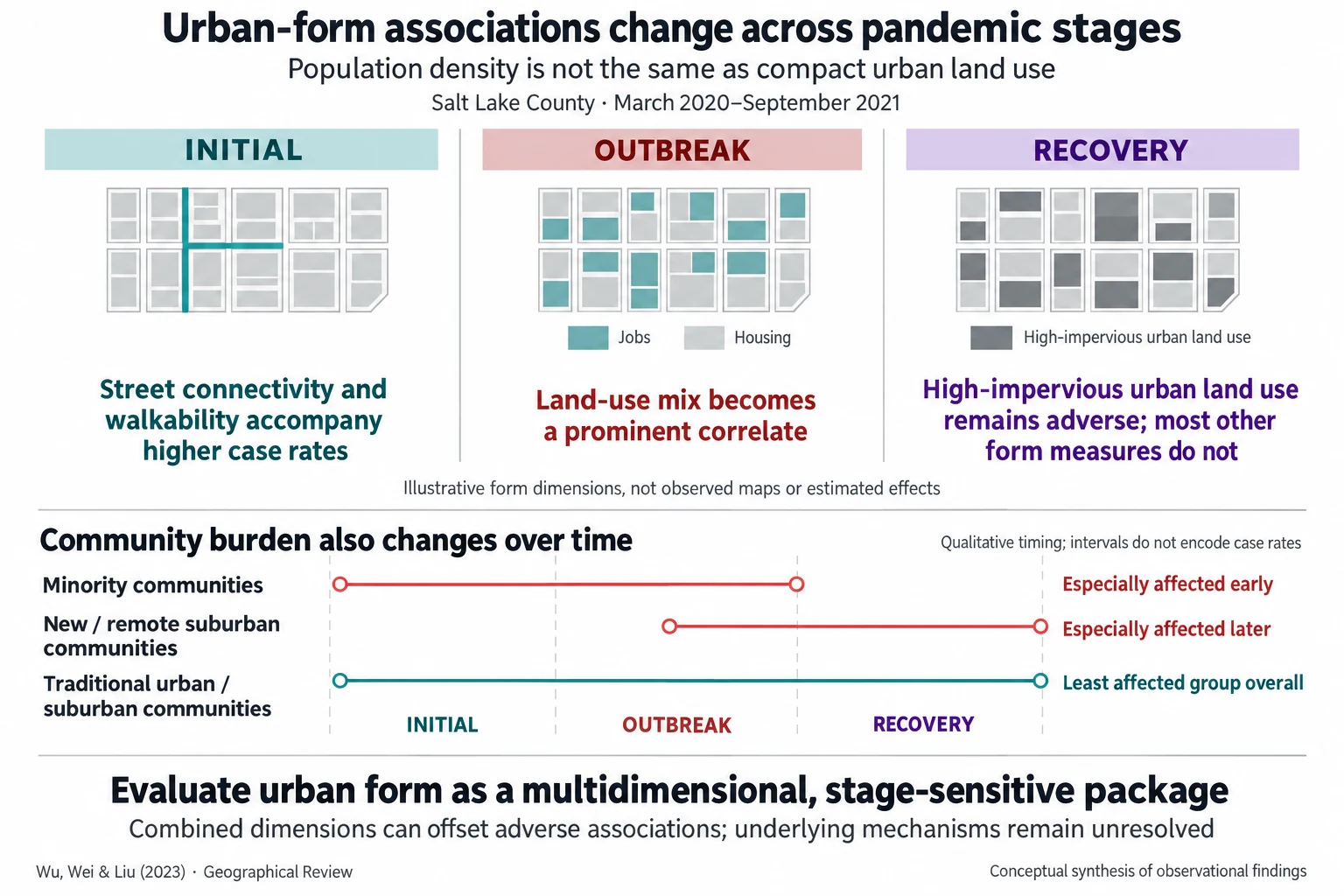
Urban-form associations with pandemic vulnerability cannot be reduced to higher density meaning higher risk or to one relationship across the entire pandemic. Comparing community types, pandemic stages and multiple form dimensions, the study distinguishes population density from highly impervious urban land use. The Salt Lake County case shows stage-dependent associations, with combinations of compact-development dimensions potentially offsetting adverse associations of individual indicators.
Findings and approach
- The analysis combines dynamic-time-warping clustering and stage-specific beta regression for 34 residential ZCTAs, March 2020-September 2021. Minority communities are especially affected early and during the outbreak; new and remote suburban communities are especially affected during the outbreak and recovery.
- Street connectivity and walkability accompany higher initial case rates; land-use mix becomes prominent during the outbreak. Highly impervious urban land use remains adversely associated during recovery, while population density and other form dimensions do not share a uniform risk direction.
- The multidimensional results support interpreting compact development by stage and local context, not rejecting it or endorsing it unconditionally. Limited samples, testing conditions and time coverage constrain interpretation; underlying mechanisms remain unresolved.