Preferences and Barriers of Vulnerable Urban Populations in Affordable Housing in Urban China
Journal of Urban Planning and Development · 2023
Contribution
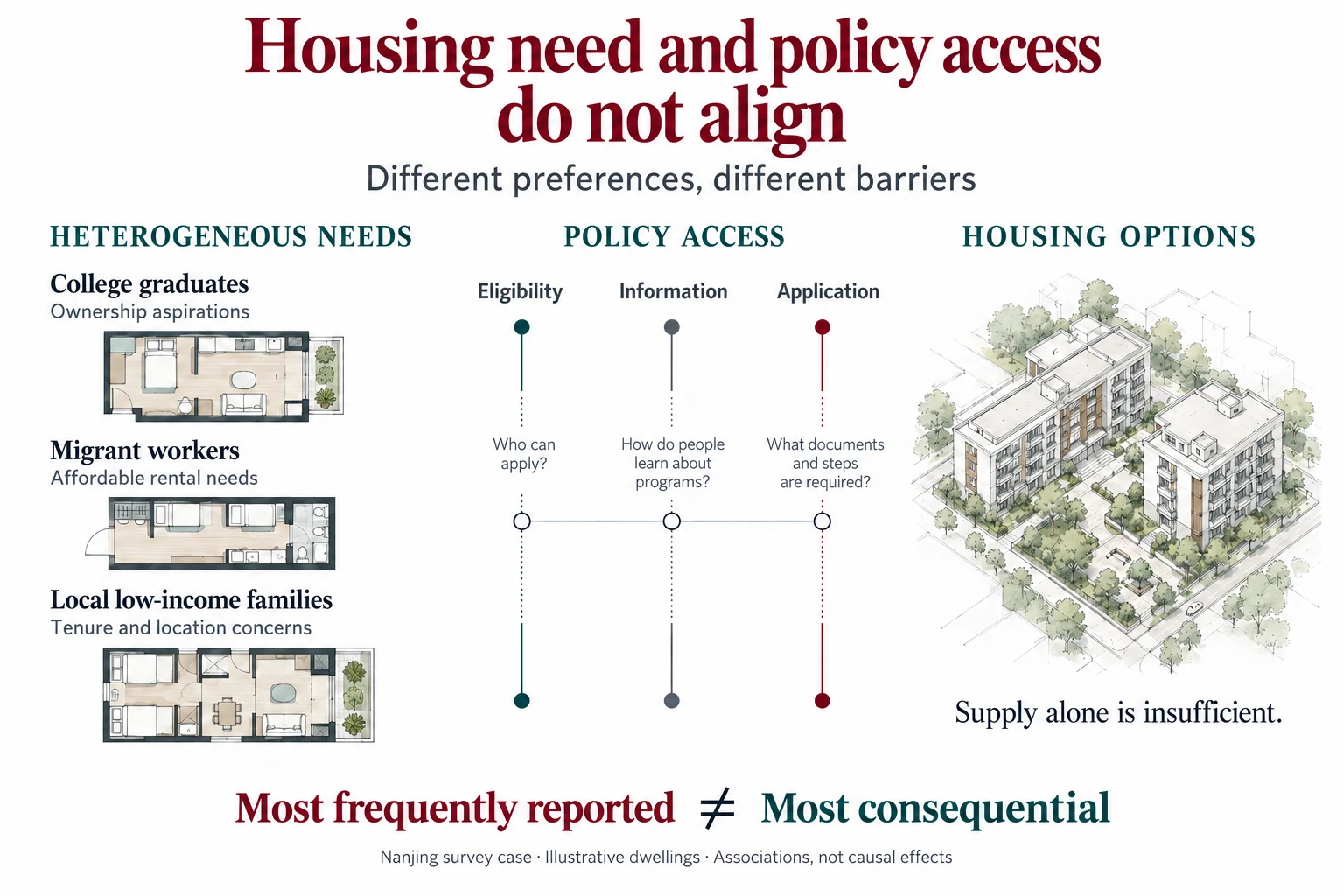
Affordable-housing problems concern policy access and heterogeneous preferences as well as supply. The Nanjing survey identifies mismatches among graduates, migrant workers and local low-income families, particularly barriers facing migrants with strong housing needs. It also distinguishes how often a problem is reported from its association with dissatisfaction, showing why the most visible supply or location concern is not necessarily the most consequential barrier.
Findings and approach
- The 2016 survey and 2018 follow-up yield 822 validated observations for comparisons of three population groups.
- Information, procedures and policy coverage matter to satisfaction; dwelling counts and remoteness do not capture these barriers.
- Migrant rental needs and policy access are mismatched in the historical case, not a statement about current eligibility rules.