Advancing Multi-Scale Geographic Environmental Monitoring: A Synthesis of Cutting-Edge Research and Scalable Solutions
Land · 2025
Contribution
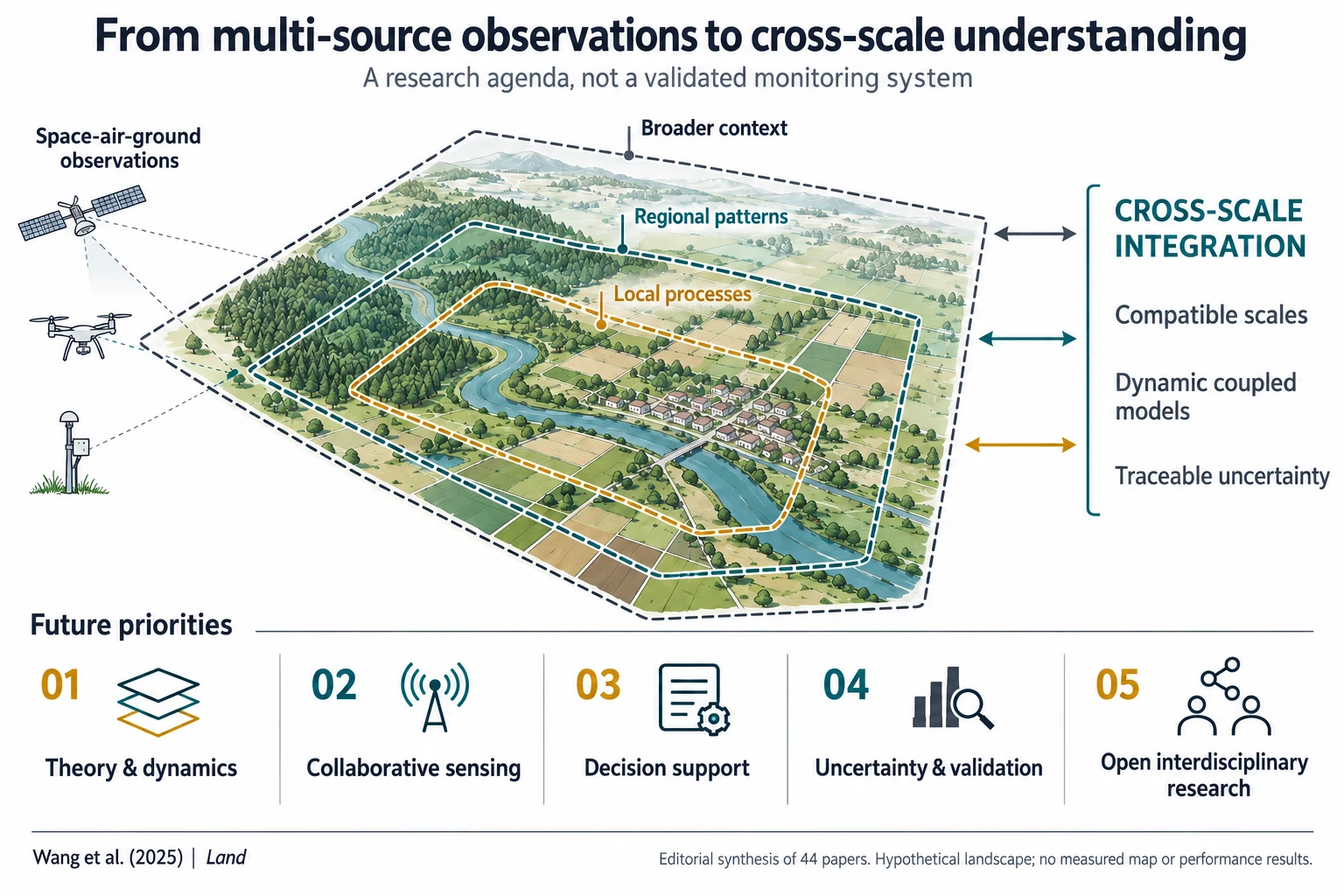
This editorial synthesizes 44 topic papers and shifts attention from acquiring more observations to understanding how environmental processes interact across scales. Multi-source integration requires scale compatibility, dynamic coupling and explicit treatment of error propagation; finer resolution alone does not ensure more complete geographic understanding. The contribution is a research agenda for theory, technology and applications, not a validated monitoring system.
Findings and approach
- Dynamic cross-scale models and compatible classification frameworks are proposed to connect broad patterns with local processes and align natural and human dimensions.
- Space-air-ground sensing and scale conversion require calibration, error attribution and uncertainty assessment alongside denser observations or finer pixels.
- Five future priorities cover theory, collaborative sensing, decision support, uncertainty and validation, and open interdisciplinary research; performance and governance benefits require empirical testing.