Polycentric Urban Development in China: Dimensions, Effects, and Policies
Chinese Geographical Science · 2025
Contribution
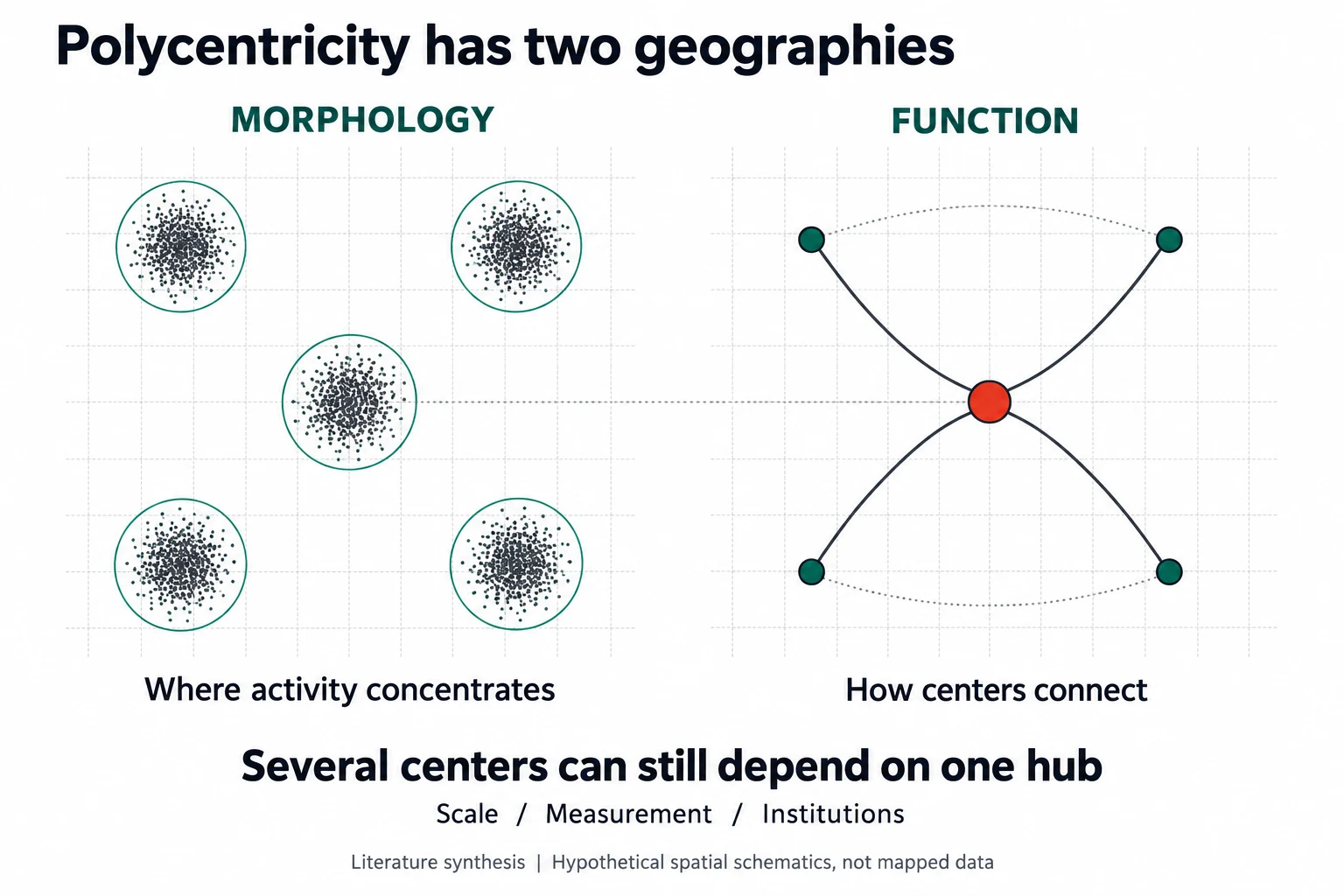
This review treats polycentric development not simply as a desired spatial form but as a question of scale, measurement and underlying mechanisms. Spatial concentrations of population or employment are distinct from functional links between centers. Counting centers alone cannot establish the degree of polycentricity or guarantee efficiency, equity or environmental benefits.
Findings and approach
- The reviewed evidence describes many Chinese urban regions as strongly monocentric with emerging subcenters; centers identified through morphological and functional metrics do not always coincide.
- Economic, institutional and transportation mechanisms differ across cities and scales, with a significant role for the state.
- This is a literature synthesis, not a new nationwide mapped dataset. Long-term relationships between post-pandemic polycentricity and resilience remain open to investigation.