How Do Urban Amenities Shape Knowledge-Intensive Industry Locations within Cities? A Multi-Scalar Study of Wuhan, China
Applied Geography · 2025
Contribution
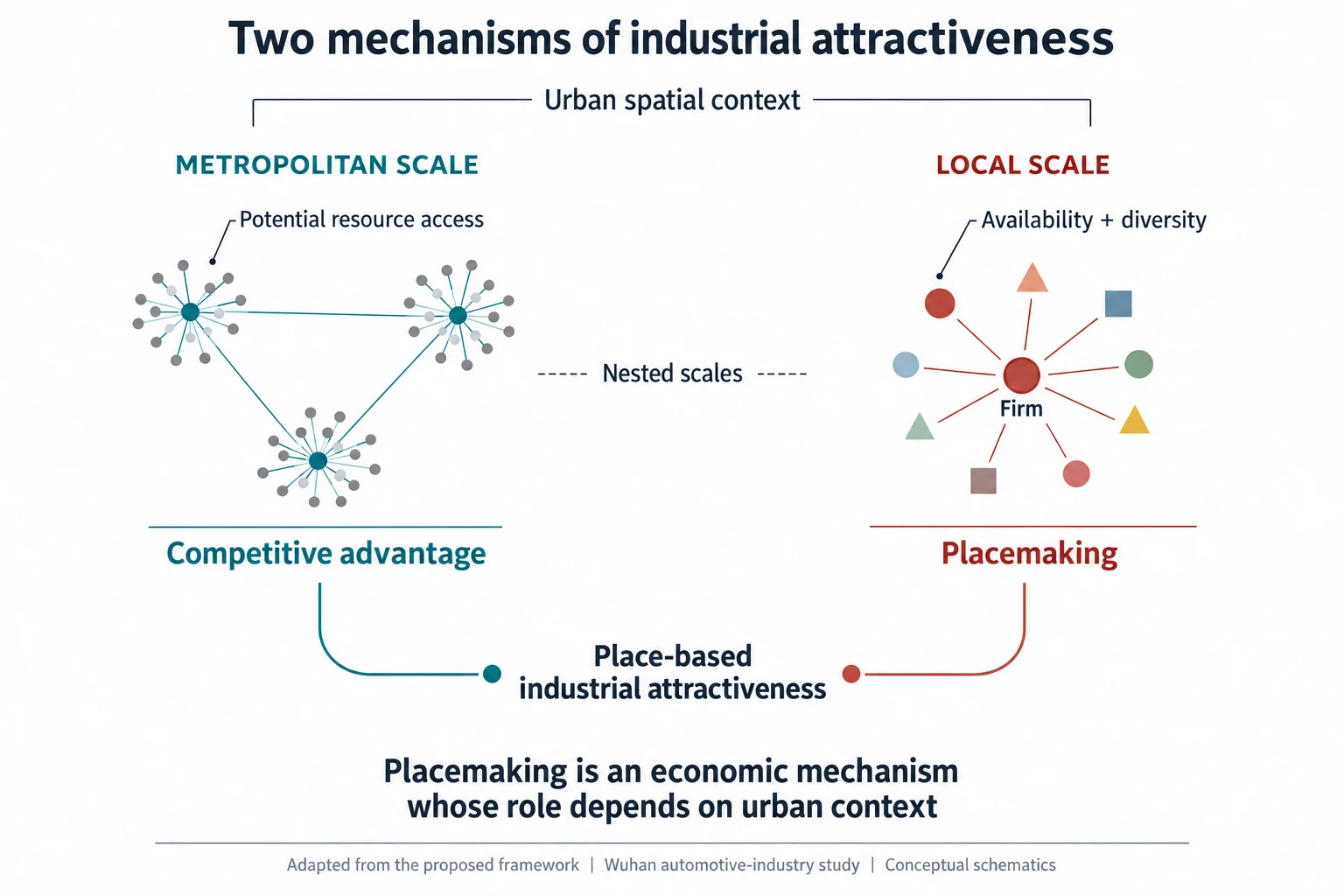
The study develops a multi-scalar framework linking urban amenities to knowledge-intensive industry location. Metropolitan amenity patterns establish potential competitive advantages across urban sectors, while local provision and diversity contribute to place-based attractiveness. It extends placemaking beyond environmental quality and social life to the explanation of industrial agglomeration, with effects dependent on each sector's functions and conditions.
Findings and approach
- The Wuhan automotive-industry case distinguishes metropolitan sectoral advantages from local attractiveness rather than treating intra-urban space as homogeneous.
- Local amenity diversity is associated with industrial clustering; high provision is especially valued for infrastructure and public services rather than consumer amenities.
- Central and peripheral areas have different amenity needs. Placemaking should fit the functions of each urban sector and the requirements of its target industries.