Dynamic Impacts of Urban Expansion on Vegetation Growth in Urban Environments: A Sustainable Land Management Framework
Land Use Policy · 2025
Contribution
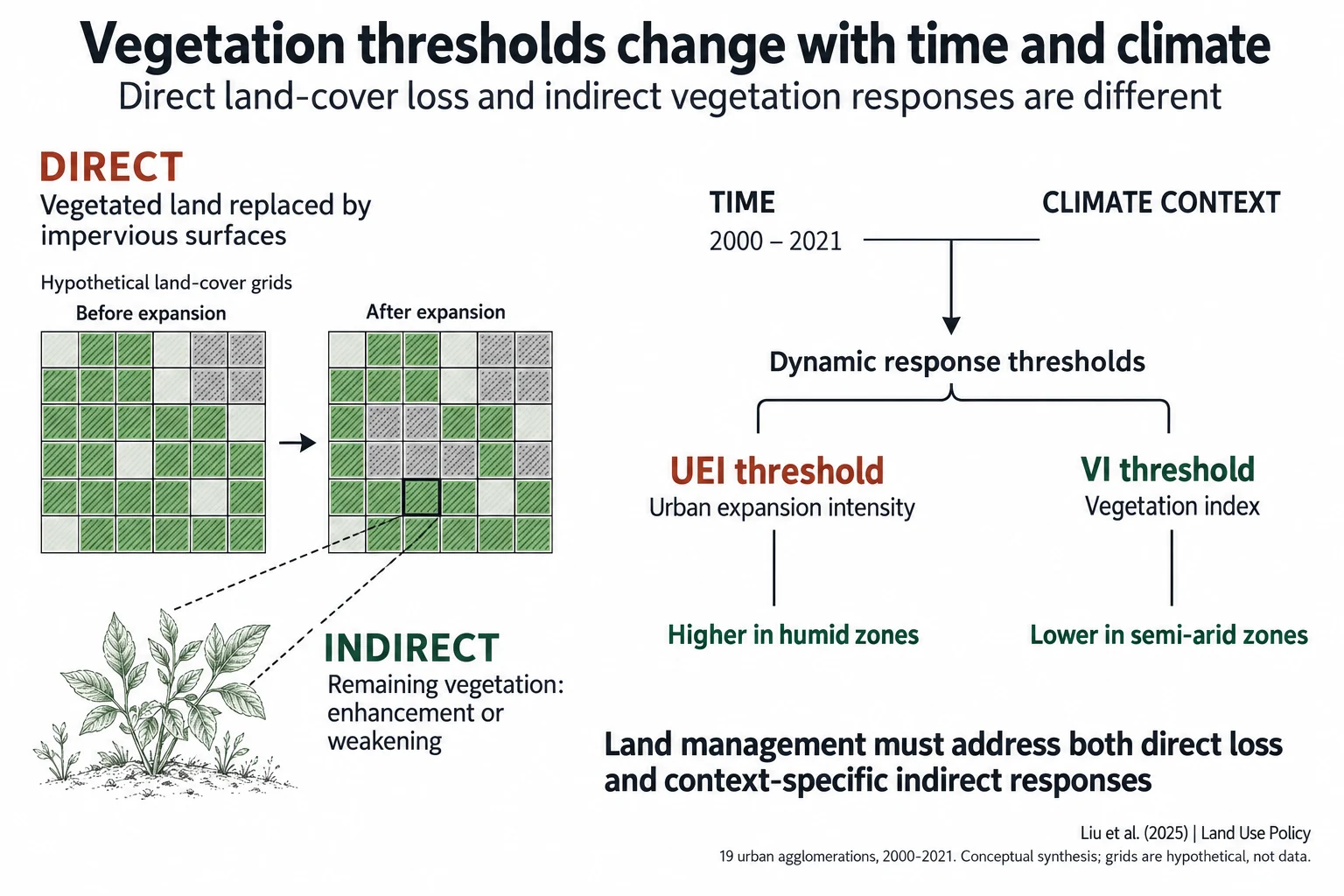
The study extends a snapshot comparison along urban-rural gradients into a dynamic framework linking expansion intensity, vegetation index and time. Its contribution is identifying two indirect-response threshold dimensions and their climate dependence. Land management must distinguish direct vegetation loss through conversion from enhancement or weakening of remaining vegetation, rather than assuming indirect greening compensates for conversion losses.
Findings and approach
- The analysis covers 19 urban agglomerations in 2000-2021, combining expansion intensity, vegetation index and time.
- UEI thresholds are higher in humid zones and VI thresholds lower in semi-arid zones; a uniform threshold is inappropriate.
- The publisher abstract reports greater contributions from human activities than climate change to threshold variation. Zoning strategies are recommendations, not experimentally validated restoration outcomes.