Assessing Urban Park Equity in China through Supply and Demand Balance: A Case Study of Wuhan City, China
Sustainability · 2025
Contribution
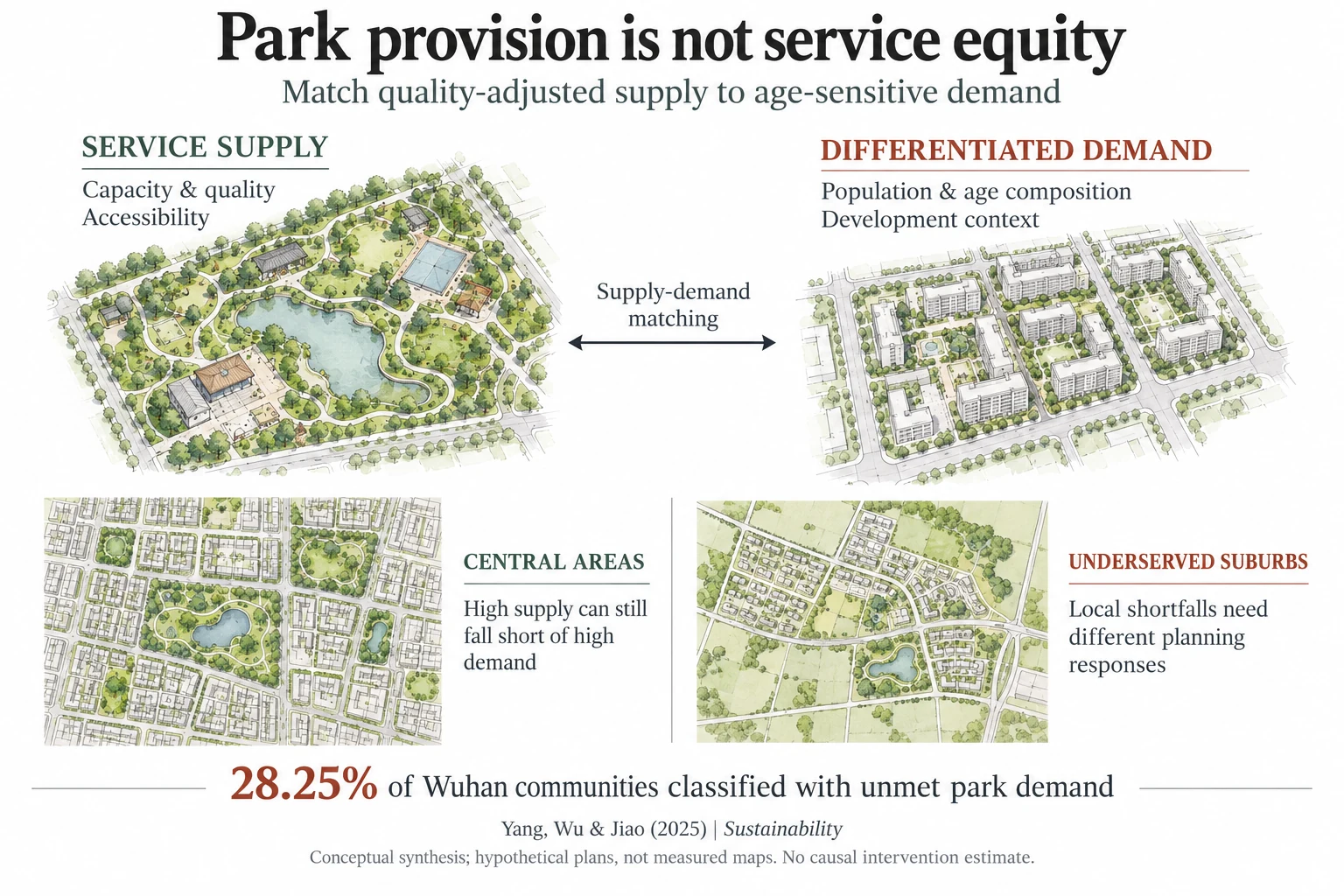
Park provision is not the same as park equity. By combining quality-adjusted service capacity and accessibility with age-sensitive demand, this study evaluates whether services match residents' needs. This explains why a well-supplied central area can still face a serious shortfall.
Findings and approach
- In the Wuhan case, 28.25% of communities are classified as having unmet park demand by relative supply-demand grades.
- Central areas combine high supply with high demand; an apparently favorable resource distribution can conceal a service deficit.
- The assessment supports different responses: upgrading existing parks in constrained central areas and addressing underserved suburban locations.