Urban Form under China's Politico-Economic Transition: The Role of Decentralization, Marketization, Globalization, and Regionalization in the Greater Bay Area
Land Use Policy · 2026 · Co-corresponding author
Contribution
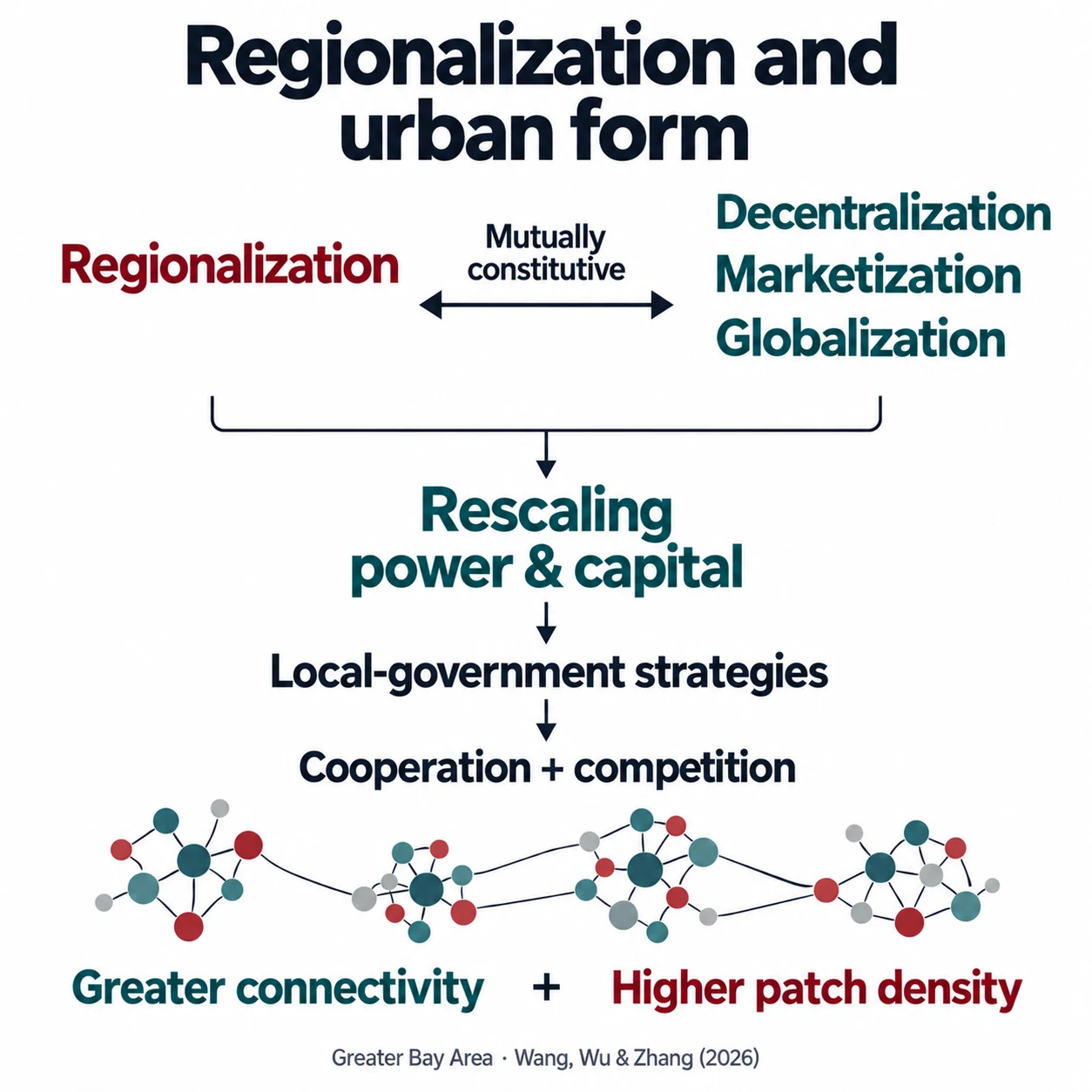
The study conceptualizes regionalization as a rescaling of state power and capital allocation, extending decentralization, marketization and globalization into a quadruple-process framework. It explains urban form through the changing relations between local governments, capital and intercity cooperation. Evidence from the Greater Bay Area shows that cooperation can improve patch connectivity and land-use diversity without fundamentally displacing land-driven local growth. Urban restructuring operates through a compound growth model involving industry, transport infrastructure and real estate, rather than property development alone.
Findings and approach
- Regionalization is mutually constitutive with the other transition processes: it responds to imbalances generated by intercity competition and reshapes local government strategies and capital location choices.
- Intercity cooperation is associated with higher patch connectivity and land-use diversity, but also higher patch density. Connectivity and fragmentation can coexist; cooperation should not be equated with compact development.
- Mechanism analysis distinguishes industry's moderating role from infrastructure and real estate mediation pathways. Sectoral investment can amplify or offset the morphological effects of the same transition process.
- Core-periphery differences depend on the morphological outcome. Under regionalization, responses differ in aggregation, shape complexity and connectivity, but not significantly in urban area, patch density or land-use diversity.
- The study covers 11 Greater Bay Area cities in 2010-2019, measuring six dimensions of urban form with 30 m land-cover data and using two-way fixed effects, moderation analysis and PLS-SEM. Investment mechanism analysis covers only the nine mainland cities because of statistical differences; these models do not establish policy-experiment causal identification.