Urban Sprawl
The Encyclopedia of Human Geography · 2026
Contribution
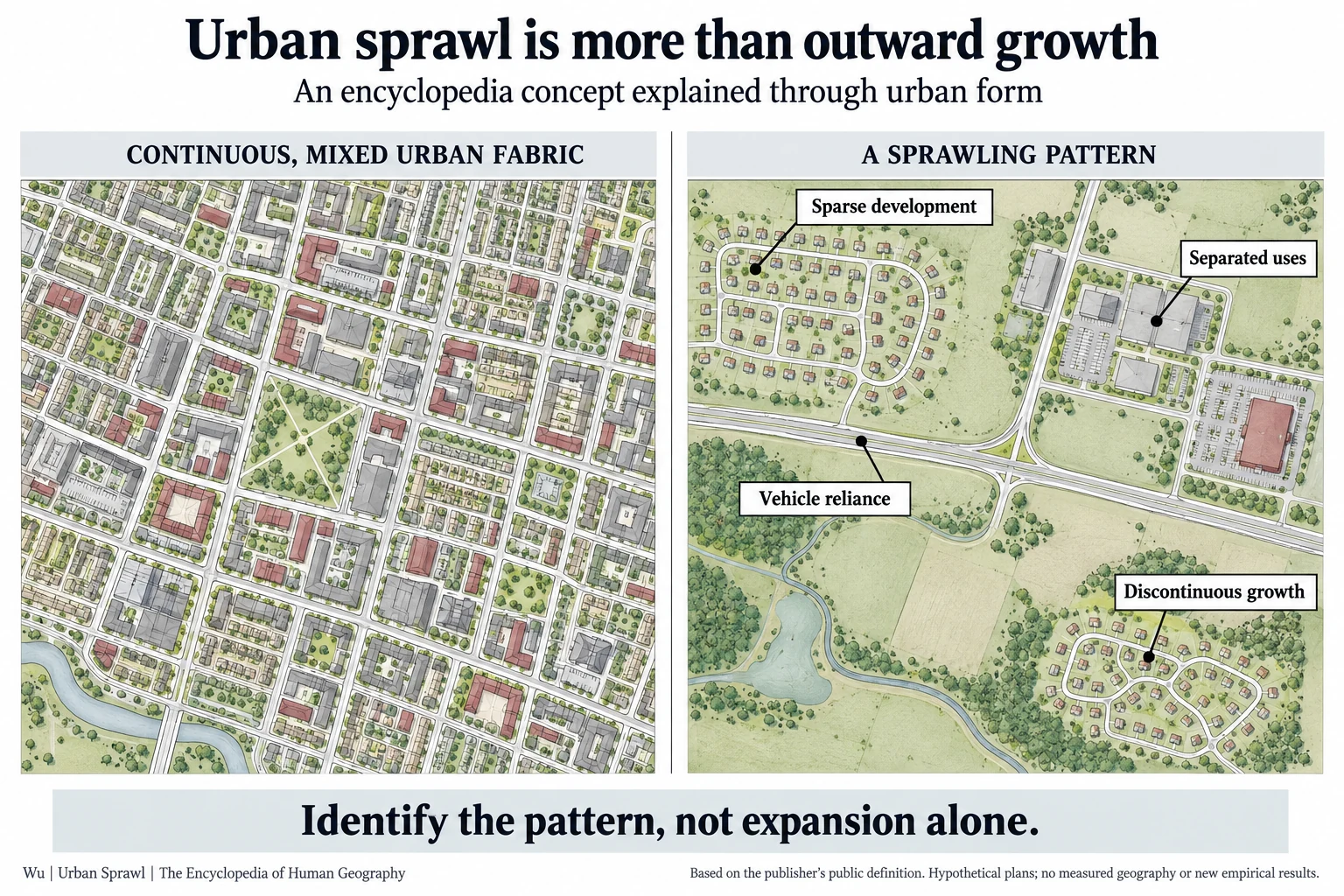
This encyclopedia entry explains urban sprawl as a spatial pattern involving development density, land-use separation, vehicle reliance and discontinuous building. The verified public definition distinguishes the concept from outward growth alone. This is conceptual reference material, not a new empirical study or a validated governance intervention.
Findings and approach
- The public definition links sprawl with sparse development, separated uses, vehicle dependence and leapfrog building, rather than expansion alone.
- Housing, employment and service separation help explain the pattern; illustrated roads do not represent measured traffic volumes.
- This overview is limited to the publicly readable definition. Hypothetical plans do not depict actual cities or intervention outcomes.