Analyzing Spatial Heterogeneity of Housing Prices Using Large Datasets
Applied Spatial Analysis and Policy · 2020 · First author
Contribution
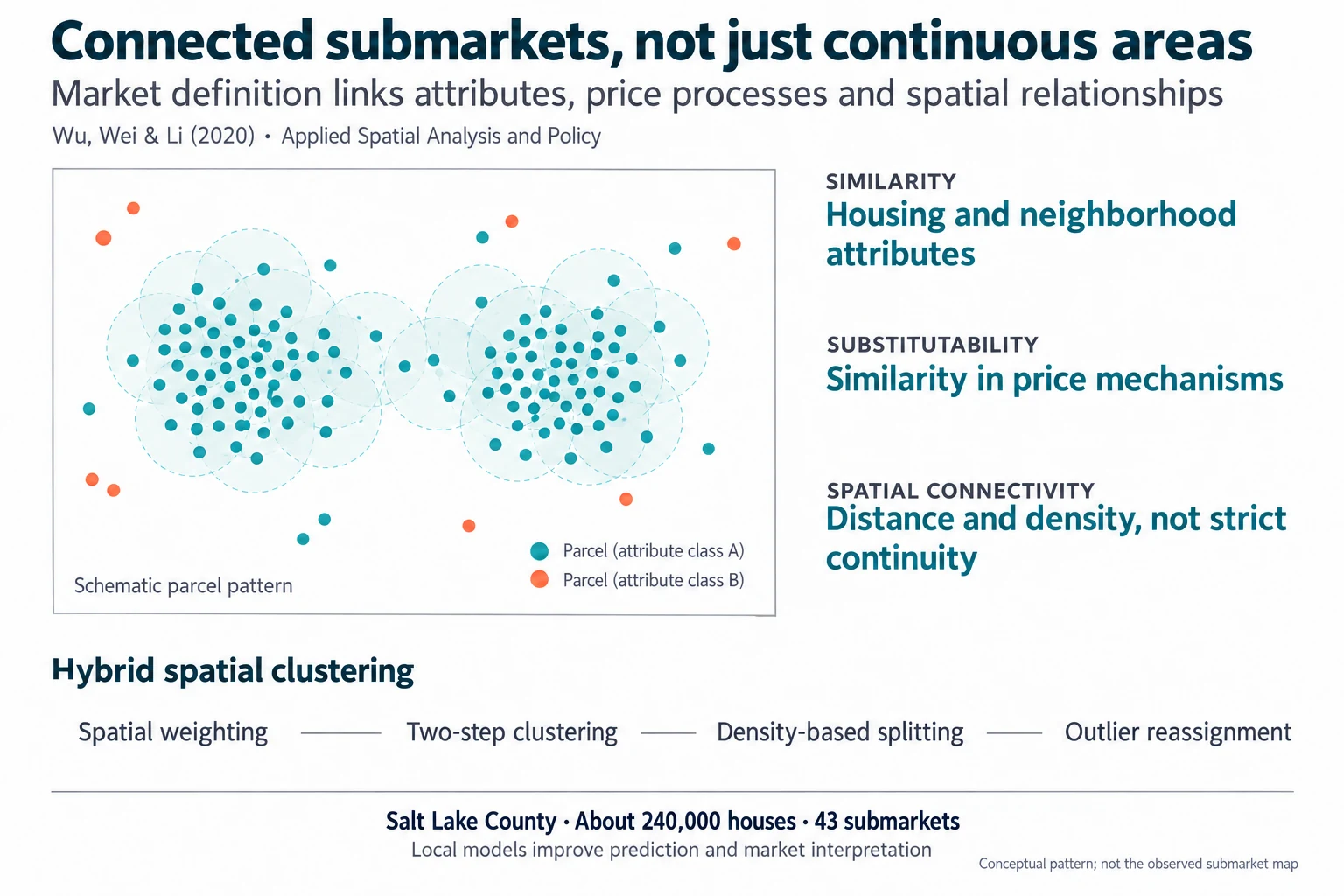
Housing submarkets need not be defined by simple spatial continuity. This study combines similarity, substitutability and spatial connectivity in a hybrid classification method, linking the definition of local markets to the price processes that operate within them.
Findings and approach
- The Salt Lake County case uses a dataset of about 240,000 single-family houses and identifies 43 submarkets.
- A hybrid spatial data-mining procedure balances attribute similarity, spatial relationships and computational feasibility.
- Submarket-based models improve prediction and the interpretation of local housing markets relative to a non-submarket model.