Multidimensional Neighborhood Amenity Characteristics and Housing Prices in Urban China
Applied Spatial Analysis and Policy · 2025
Contribution
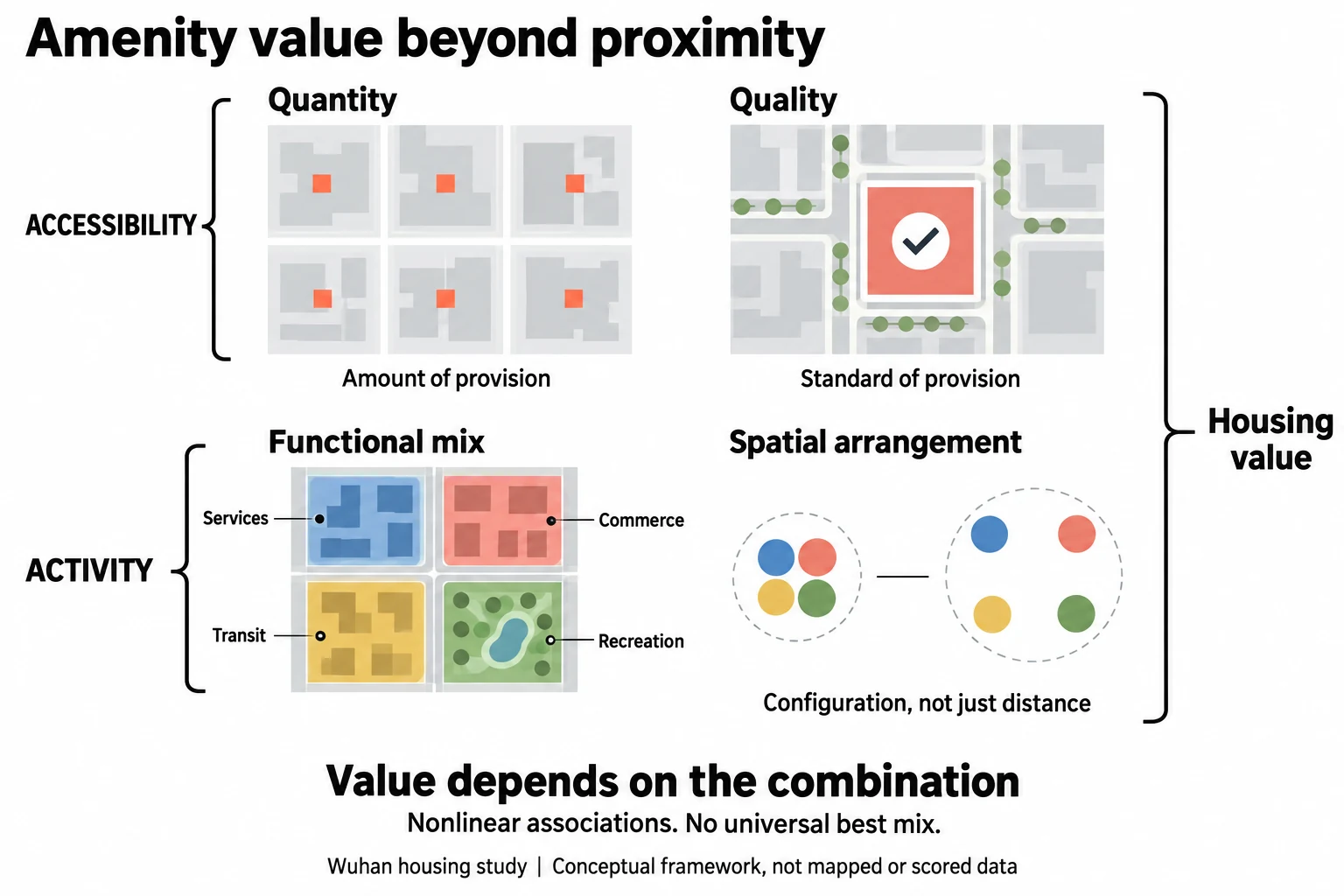
The study extends the explanation of amenity value beyond proximity and counts to the configuration of neighborhood resources. Quantity and quality describe accessibility, while functional mix and spatial arrangement describe activity conditions. The framework links which amenities are available with how they jointly support daily activities, helping explain why similar provision can have different housing-value associations across configurations and urban contexts.
Findings and approach
- The Wuhan case combines linear regression and XGBoost-SHAP to examine quantity, quality, functional mix and spatial arrangement.
- Private services rely more on quality in their housing-price associations, while both quantity and quality matter for essential services.
- Nonlinear and threshold patterns suggest different preferences across central, suburban and peripheral contexts. Cross-sectional evidence does not establish causality.